
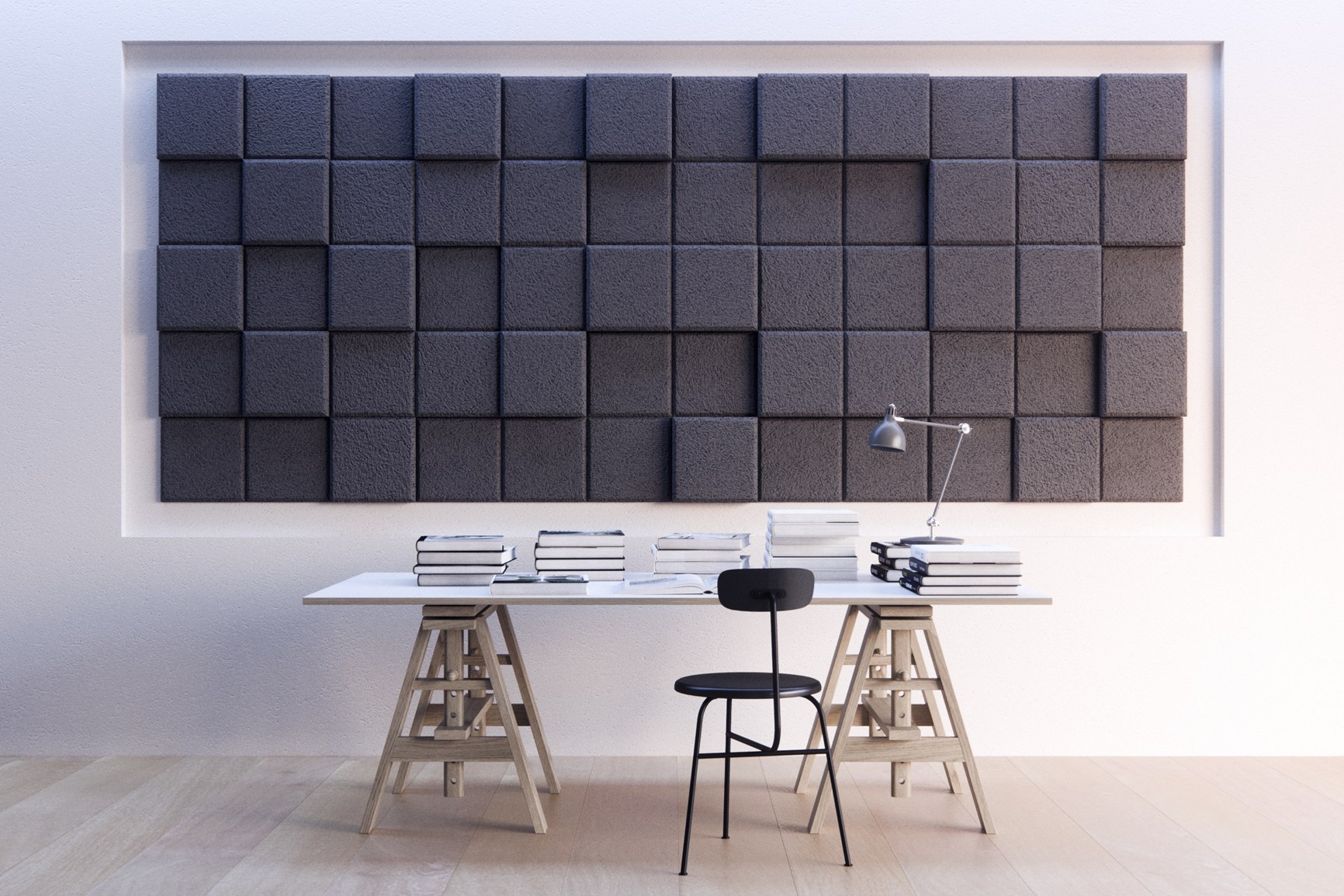
SOUND ABSORBING PANELS: INTRODUCTION
The sound absorbing panels are coatings made with the aim of obtaining the acoustic insulation of a room.
The goal of these materials is to limit the propagation of sound waves, which can be greater in the materials that make up the walls of walls even than in air, so that very loud sounds coming from a wall are perceived as greater than what they actually are, in the absence of these panels.
When you want to limit, from both sides, the propagation of sound waves, both inwards and outwards (for a music recording room), soundproofing panels are the best solution to consider.
WHAT ARE THEY FOR?
The purpose of these products is to limit the reverberation of sound inside closed environments. In confined spaces, in fact, the noise that is perceived is greater than that actually produced, and also depends on the heights of the walls, the materials in which they are made and the size of the room.
This creates significant noise pollution. The sound-absorbing panels therefore serve precisely to absorb and cushion sounds by limiting the intensity of perceived noises.
The soundproofing panels are the ideal solution for those who live in very noisy urban areas, or for offices located in central areas of the city, as noise disturbs and compromises worker performance.
OPERATION
From a physical point of view, sound waves are oscillations that propagate through matter. In particular, sound is a thickening and sudden rarefaction of the atoms present in the material in which it propagates, and these variations can be perceived by our ears. In the absence of atoms, for example in space, we do not have the propagation of sounds.
A material absorbs a sound by virtue of its porosity. The air inside the material is vibrated by contact with the sound wave and converts its energy into heat.
In fact, it is put into vibration with contact with the sound wave and converts its energy into heat. Another decisive factor is the acoustic transparency, determined by the amount of air that a material is able to absorb during the sound vibration process; the greater the quantity, the greater the absorption capacity
When a sound meets a material other than air, the sound wave is partly reflected, partly transmitted and absorbed.
The material is very important from this point of view, because for example a sheet of paper will completely transmit the sound wave by absorbing a very small part, while a thick concrete wall will absorb and reflect most of the wave by transmitting little.

ABSORBING
What is interesting in the sound-absorbing panels is precisely the absorption, or the fact that the sound is neither reflected nor transmitted. The absorption mechanisms, taken from the panels, are three:
- by porosity: in this case the panel is made up of a series of pores, in which the vibrating air remains trapped and the vibrations are discharged onto the material around it in the form of heat, dissipating the sound.
- by membrane resonance: it is a type of absorption in which the energy of the sound wave is neutralized by the fact that the panel has the ability to oscillate. This oscillation holds the sound wave and prevents its transmission.
- by cavity resonance: the sound arrives in a cavity and is reflected there, but part of the energy is absorbed. The part that resonates still remains in the cavity, being absorbed again until the sound completely dissipates.
Usually, these absorption techniques are used simultaneously in sound-absorbing panels to enhance the effect.
Ultimately, it can be said that a sound-absorbing panel is built with a material that has a high porosity and at least sufficient acoustic resistance.
SOUND ABSORBING VS SOUND INSULATING
The distinction between sound-absorbing material and sound-insulating material is very important: the former absorbs sound, while the sound-insulating material does not absorb it, but reflects it back and turns it back as if it were a barrier.
While it is usually stand-alone panels that are sound-absorbing, it is usually the building structure that is sound-insulating, which must make a way that sounds do not propagate from one side of the wall to the other. A very common sound-insulating material is concrete, we then find panels acoustic insulation made fromgalvanized steel or the rarer lead or aluminum.
With the combination of both, the sound-absorbing panel will have fewer sounds to absorb (blocked first by the sound-insulating panel), and the end result will be better.

APPLICATIONS
The applications of acoustic panels are many, and different panels are chosen for each use. Among the most popular applications we can find:
- Acoustic insulation of floors: it is used to not make noise to people who are on the upper floor, for example in the case of a bar under an apartment building.
- The acoustic insulation of the walls: it is used to prevent the noise of two adjacent rooms from being heard, or to prevent external noises from being heard. For some structures they are particularly important, for example for music recording rooms.
- Acoustic insulation of ceilings: has the purpose of isolating the noises that come from the upper floors, such as the footsteps of other tenants or the noises coming from the roof.
- Interior acoustic insulation: usually done in the external wall of the building, and is used to prevent external noise from being heard, or to soundproof small buildings and prevent sound from spreading outside.
SOUND ABSORBING PANELS: MATERIALS
Below we will analyze the existing types of sound-absorbing panels, trying to understand what are the positive and negative sides of each material used to build them.
SOUND ABSORBING PANELS IN FABRIC
These are particularly lightweight panels, which provide less insulation but can be customized a great deal, both in shape and size, and are also suitable for “dangerous” spots such as ceilings (in fact they usually have just such a use).
The panel internally has a fabric, whose fibers are irregularly spaced apart, whose purpose is to ensure sound absorption, which will be the stronger the greater the thickness of the panel.
They are not the best for result, but they are chosen in situations where too heavy materials cannot be used.
SOUND ABSORBING PANELS IN METAL
Available in both steel and aluminum, they are metal panels with a series of holes that are intended to absorb sounds; the size of the holes, and their frequency, determine the absorption by cavity resonance.
They are very heavy and form the outer structure of the panel, which usually contains other materials inside to amplify the absorption effect.
WOOD ABSORBING PANELS
The structure is very similar to that of metal sound-absorbing panels, and so is the principle of operation; what clearly changes is the material.
They are used in situations for which metal is excessively heavy, and for special jobs because of the greater ease of working with wood.
SOUND ABSORBING PANELS IN EXPANDED SYNTHETIC MATERIALS
It is the most common type of sound-absorbing panels, even if from the aesthetic point of view it is not the best; are those used, for example, in recording rooms. They are simple to work with and are not heavy, they can be colored and are extremely customizable thanks to the construction material.
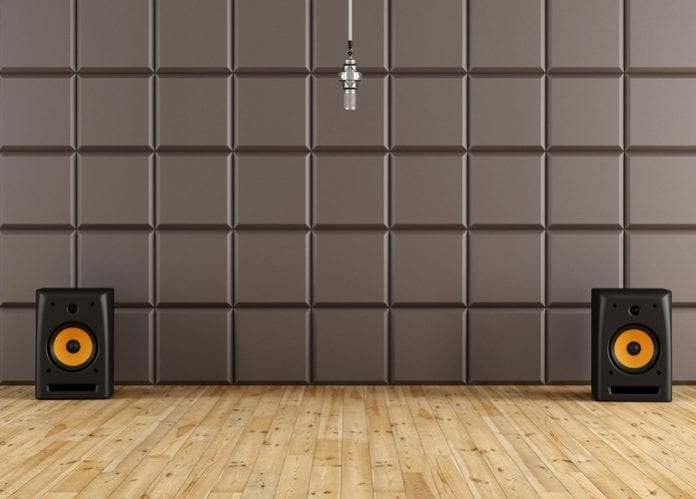
SOUND ABSORBING PANELS: HOW ARE THEY MADE INSIDE?
The sound-absorbing panels we have discussed are those that make up the outer part of the panel. On the inside, however, there are other absorbing materials to take advantage of more than one type of absorption among those we discussed earlier.
GLASS WOOL AND ROCK WOOL
These are filaments derived from glass, or from rock, which are very thin and exploit absorption by porosity, that is, dissipation into heat due to their chemical structure.
Lightweight and sold in rolls, they are suitable for all kinds of situations and form the interior of fabric panels but also of other types of panels.
CORK AND WOODEN CHIPBOARD
They are natural and rather lightweight solutions, similar in capacity to rock wool but less convenient to use because they cannot be bent (the chipboard is pressed into the panel).
EXPANDED POLYURETHANE
It is the most famous and widely used absorbent material, and can be smooth, perforated or pyramid-structured depending on uses.
It is formed from a polyurethane foam, so it is particularly easy to work with, and if there is a need to insert it in rather tight spots it can be insufflated while it is still in foam form.
It is one of the most versatile materials, and can be used alone or within the other panels.
OTHER ABSORBENT MATERIALS
Other expanded absorbent materials are melamine, vermiculite, perlite, clay, polyethylene and polystyrene (polystyrene); the characteristics are similar to those of poluirethane, the possibility of expansion changes which makes the individual materials suitable for different types of needs.
WHERE YOU CAN BUY THEM
Sound absorbing panels can be purchased in any building materials store. In this case, you can take advantage of the advice of an industry expert or a seller, who can provide advice on purchasing the most effective product according to your needs.
An alternative would be to turn to the various e-commerce sites online, or to large retail chains. In this case, however, it pays to already have a clear and precise idea of the product you want to buy, or at least to the characteristics it should possess.
PRICE
There are various types of panels and materials that can be used and each one, obviously, has its own price range, for example in:
- polyurethane or melamine foam (low thickness): from 7 to 10 euros per square meter;
- polyurethane foam or melamine (high thickness): from 10 to 70 euros per square meter;
- rock wool (low thickness): from 4 to 15 euros per square meter;
- rock wool (other thickness): from 15 to 60 euros per square meter;
- wood: from 60 to 90 euros per square meter.

HOW TO CHOOSE
The types and materials are numerous, so it is not at all easy to choose the soundproofing panel suitable for our needs.
If the main need is to reduce reverberation in contexts characterized by medium and high frequency sound waves, such as recording and radio studios, preference should be given to sound-absorbing panels made of rock wool or melamine foam. In this way, targeted absorption is obtained at a low cost.
If the sound waves, on the other hand, are low frequency, then the advice is to turn directly to resonant devices, which in this case are the only ones that offer protection from reverberation.
If, on the other hand, the need is not functional but only aesthetic, then sound-absorbing panels in wood chipboard should be preferred. In fact, wood has a natural elegance.
HOW TO SAVE
Just as the range of products, the range of prices also varies widely. The opportunities for savings, therefore, are there. There are two tips in this regard.
Reasoning according to your needs. Only if you really know your needs will you be able to choose the effective product, avoiding spending more than the right amount on a product that boasts features that are simply unnecessary.
Request more quotes and view more catalogs. The best way to purchase a product with the best value for money is to proceed with a competitive analysis of prices and quotes. Once all information has been gathered, the best possible purchase can be made.
LEAVE A COMMENT
Sound-absorbing panels are an excellent solution to better manage noise and sound waves within your home and work environments. The great variety of models allows you to choose the panel that is perfectly adaptable to the customer’s needs and useful for any type of open space.
Also, in case you are planning to place sound-absorbing panels inside your spaces but don’t know which is the best material to choose or the ideal location to suit your purposes, please feel free to leave a comment at the end of the article! We will get back to you as soon as possible!