
Introduction
The bathroom sink is one of the most important elements in the design of the wash area. It is not only a functional sanitary ware, but a real protagonist of the bathroom furniture: it defines the style of the room, influences the choice of bathroom furniture, conditions the faucets, and determines the everyday practicality of use.
Today, there are many different solutions: countertop washbasins, wall-hung washbasins, semi-recessed washbasins, integrated into the top, freestanding, or floor-standing washbasins. Each type has specific characteristics and is best suited to certain spaces, styles and needs.
Choosing the right washbasin means finding the right balance between aesthetics, size, convenience, maintenance, and matching with other bathroom elements, such as bathroom cabinet, bathroom mirror, washbasin mixer, and bathroom accessories.
In this guide, let’s see how to choose the right sink for your environment.

Why the washbasin is so important in bathroom furniture
The washbasin is one of the elements most used every day. That’s why it must be beautiful to look at, but also comfortable, durable and proportionate to the available space.
Correct choice makes it possible to:
- Make the sink area more functional;
- Enhance the bathroom cabinet;
- Improving the order of the support plane;
- Complete the style of the bathroom;
- Optimizing space in small bathrooms;
- Create continuity with mirror, faucets and wall tiles.
Therefore, the washbasin should not be chosen in isolation. It must dialogue with the rest of the composition: cabinet, top, mirror, mixer, lighting and accessories.

How to choose the right bathroom sink
Before choosing a sink, it is useful to consider some practical aspects.
The main ones are:
- bathroom size;
- width and depth of the cabinet;
- location of drains;
- type of faucet;
- frequency of use;
- style of the environment;
- ease of cleaning;
- Need for floor space.
A master bathroom may allow for a large and dramatic sink. In contrast, a small bathroom requires more compact and functional solutions. A modern bathroom can be enhanced by a countertop or built-in sink, while a classic bathroom can accommodate softer, more traditional forms.
The best choice is not always the most decorative, but the one most consistent with everyday use and the proportions of the environment.
Types of wash basins: which one to choose?
The most popular types of washbasins are different. Each one meets different needs.
| Type | Ideal for |
|---|---|
| Countertop washbasin | Modern bathrooms, designer compositions |
| Suspended washbasin | Small bathrooms, essential environments |
| Built-in washbasin | Practical and easy-to-manage bathrooms |
| Semi-recessed washbasin | Shallow furniture and small spaces |
| Integrated washbasin | Contemporary bathrooms and clean compositions |
| Freestanding washbasin | Scenic or large bathrooms |
| Stone washbasin | Textural, natural or characterful environments |
Let’s see them in detail.
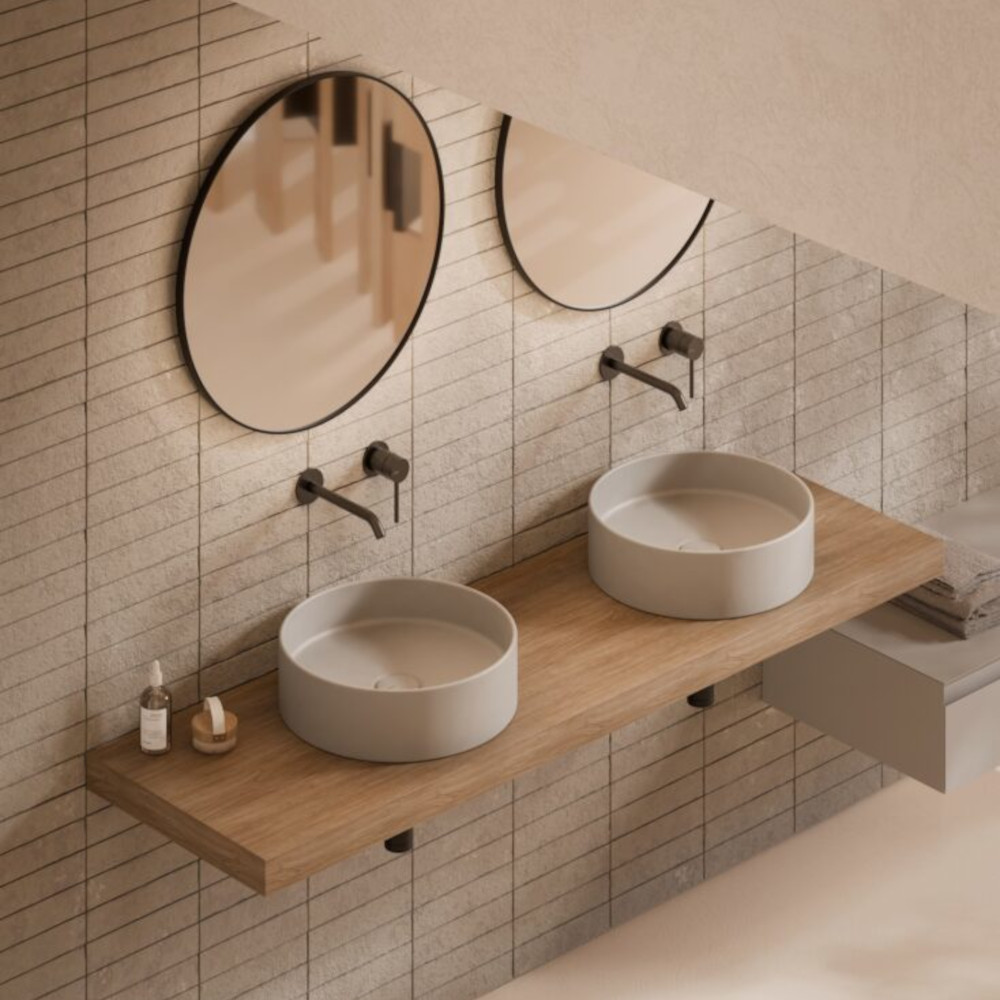
Countertop washbasin
The countertop sink is one of the most popular solutions in modern bathrooms. It is placed on top of a bathroom countertop or cabinet, becoming a very visible and decorative element.
It is ideal if you want to create an elegant, contemporary and personalized sink area.
The main advantages are:
- Great aesthetic impact;
- Wide choice of shapes and sizes;
- Possibility of combining it with different furniture and tops;
- Ideal with tall mixers or wall-mounted mixers;
- Perfect for modern, minimal bathrooms.
However, the countertop sink requires attention in the choice of faucet. If the faucet is installed on the countertop, it should be high enough to ensure comfortable use. If, on the other hand, the faucet is wall-mounted, the position and height of the spout must be accurately assessed.
It is a very suitable solution for those who want to give personality to the bathroom without sacrificing functionality.
Discover CasaOmnia countertop sinks and choose the model that best suits your bathroom cabinet.
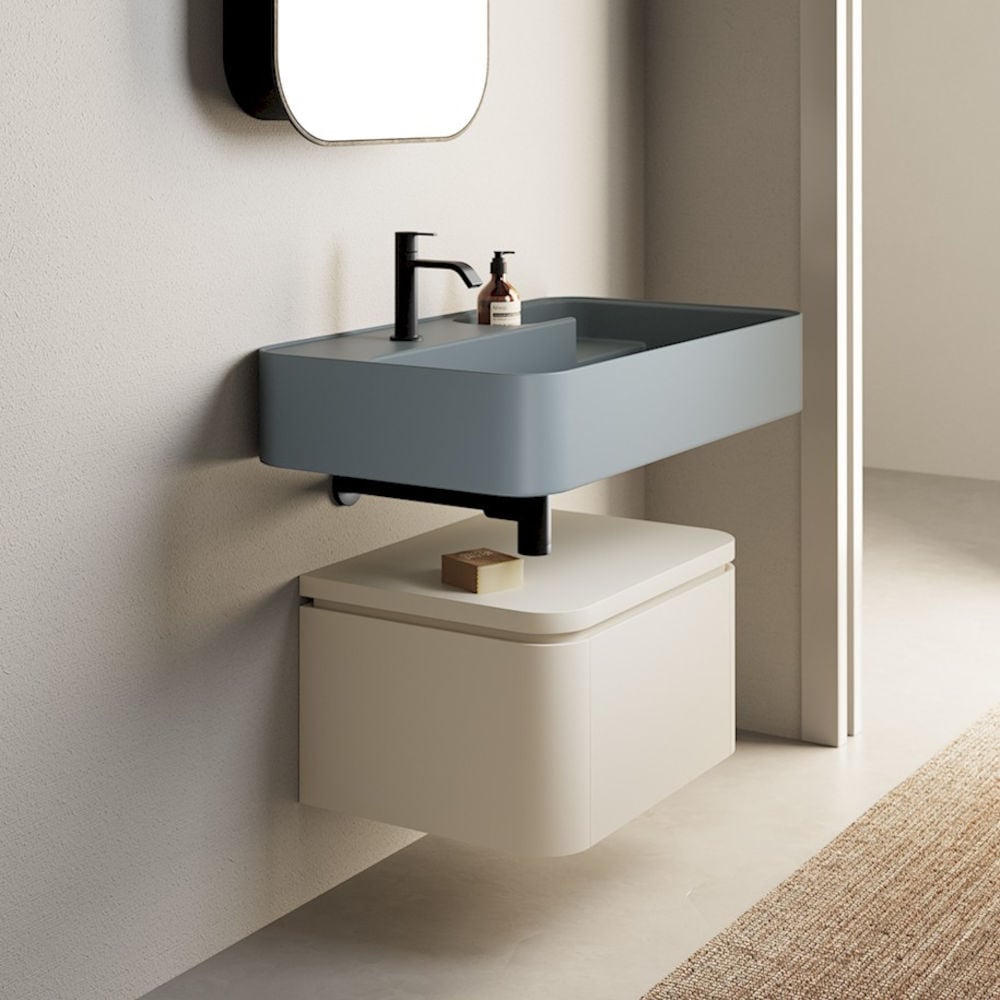
Suspended washbasin
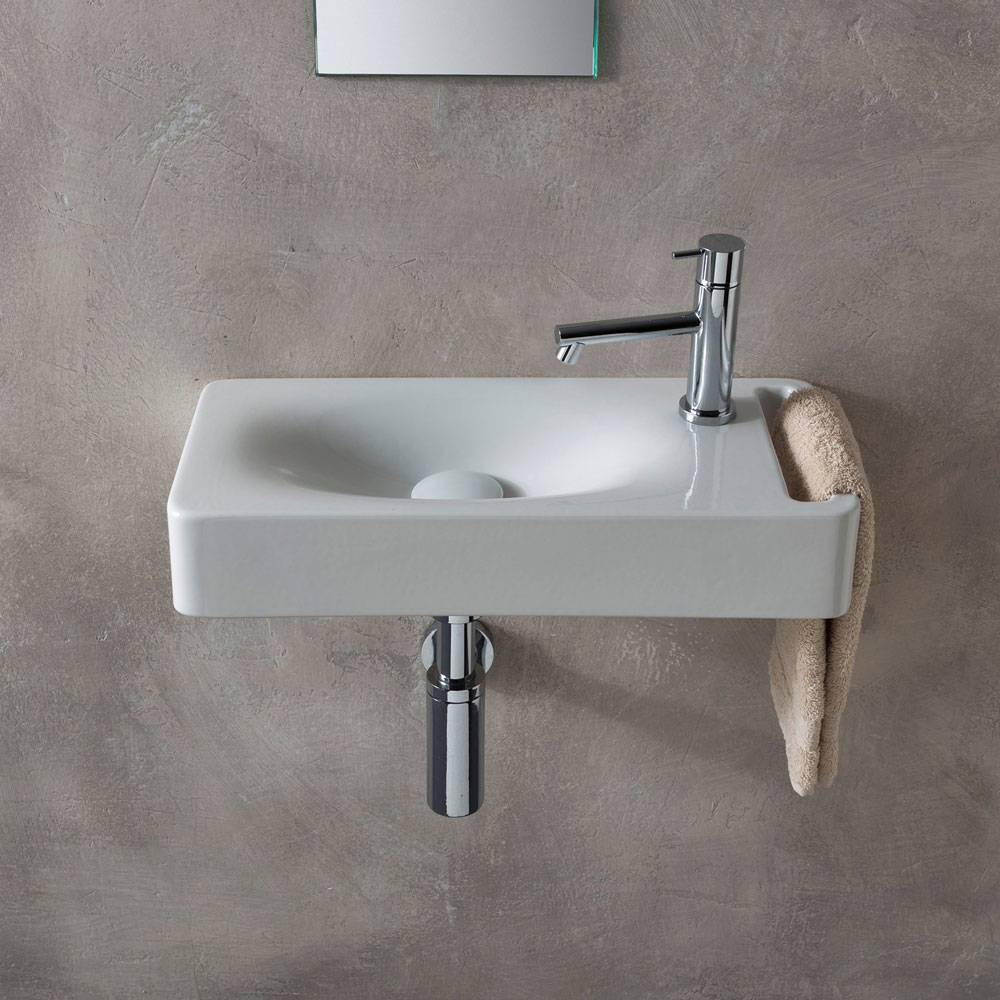
The wall-hung washbasin is attached directly to the wall and leaves the space below free. It is an essential, lightweight solution that is especially suitable for small bathrooms or rooms with a minimal style.
The main advantages are:
- Small visual footprint;
- Easier floor cleaning;
- light and modern aesthetics;
- Good solution for service bathrooms;
- Ability to create very essential compositions.
The main limitation is the lack of storage. Since there is not always a cabinet under the sink, it may be necessary to add shelves, columns or storage accessories.
It’s an attractive choice when you want a visually light bathroom, but it should be evaluated well if you need a lot of space for products and everyday items.

Built-in washbasin
The built-in washbasin is inserted inside the countertop or bathroom cabinet. It can be overtop, when the edge remains visible, or undermount, when the basin remains more integrated into the surface.
It is a practical, neat and popular solution.
Its strengths are:
- good daily practicality;
- neat appearance;
- Ideal for family bathrooms;
- Good protection of the top around the sink.
The built-in sink is less scenic than a countertop sink, but it is often very convenient in everyday use. It is suitable for those seeking a functional solution.

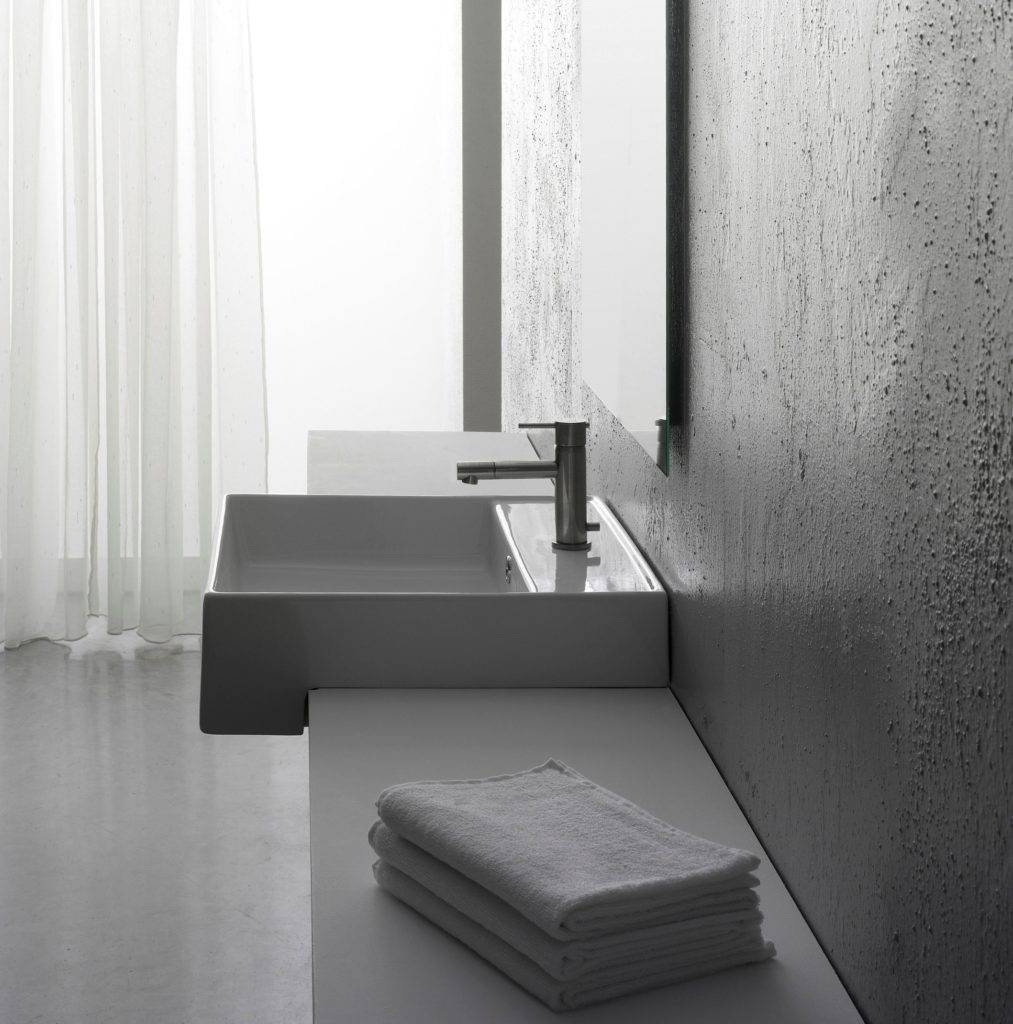
Semi-recessed washbasin
The semi-recessed washbasin is partially inserted into the cabinet, but a part remains protruding. It is a useful solution when space is limited or when furniture with limited depth is chosen.
It is particularly suitable for:
- small bathrooms;
- Shallow bathroom furniture;
- service environments;
- Narrow sink areas;
- compact compositions.
The main advantage is the possibility of having a convenient washbasin even when the cabinet does not have a standard depth. At the same time, the protruding part allows practical use.
It is a less minimal solution than the integrated sink, but very functional.
Integrated washbasin in the top
The integrated wash basin is made in continuity with the top. Top and wash basin become a single element, with a very clean and contemporary effect.
It is an ideal choice for those seeking:
- minimalist aesthetics;
- continuous lines;
- ease of cleaning;
- modern bathroom;
- Elegant and neat composition.
The integrated basin is perfect in contemporary bathrooms because it eliminates visual detachments and creates a uniform surface. However, one must carefully consider the size, depth and slope of the basin to avoid splashing or water pooling.
It is a fine solution, but it must be designed carefully.

Free-standing or freestanding washbasin
The freestanding sink, also called freestanding, is a dramatic solution. It does not need a traditional cabinet and becomes a self-contained element within the bathroom.
It is ideal for:
- spacious bathrooms;
- design environments;
- projects sought;
- representative bathrooms;
- Very well-maintained sink areas.
However, it requires more careful technical evaluation, especially with regard to drains, connections, and location of faucets. It also offers little or no storage space.
It is perfect when the goal is to create a high-impact bathroom.

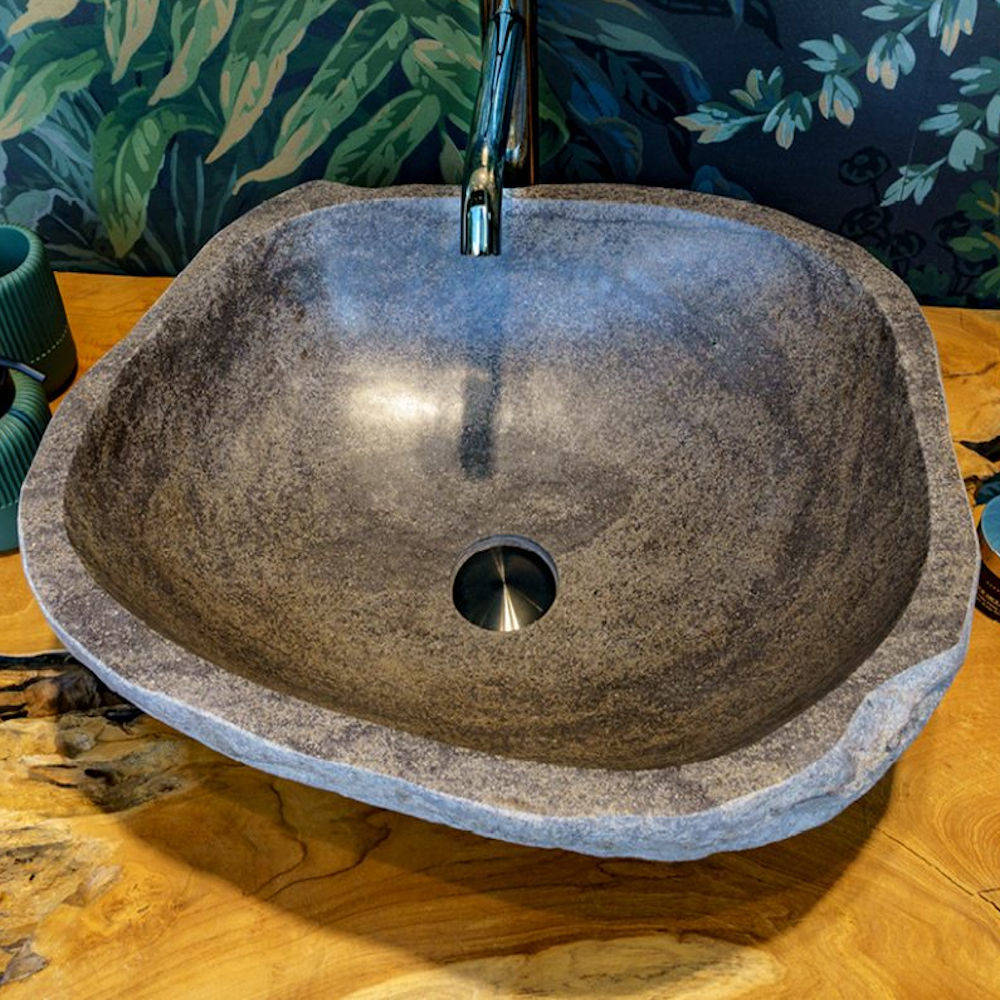
Stone washbasin
The stone sink is a textural, elegant and very distinctive choice. It brings a natural and authentic effect to the bathroom, ideal for contemporary, rustic, Mediterranean, or spa-style environments.
Pairs well with:
- Furniture in natural finishes;
- Simple or backlit mirrors;
- Black, bronze or steel faucets;
- stone effect coatings;
- Warm and sophisticated bathroom environments.
Compared with other materials, it requires more attention in cleaning and maintenance. It is therefore recommended for those who seek a strong aesthetic value and want a bathroom with personality.
Which sink to choose for a small bathroom?
In a small bathroom, the sink must be chosen with special care. The goal is to provide convenience without weighing down the space.
The most suitable solutions are:
- suspended basin;
- semi-recessed washbasin;
- compact countertop washbasin;
- Integrated sink in a shallow cabinet;
- Narrow rectangular basin;
- Corner sink, if space is very limited.
In general, it is best to avoid sinks that are too large or too deep if they obstruct passage. The under-sink cabinet should also be proportionate: in some cases, a suspended base unit helps to make the bathroom lighter.
To increase the perception of space, you can combine the washbasin with a large bathroom mirror or one with a built-in light.
Washbasin shapes: round, oval, rectangular or square?
The shape of the sink greatly affects the final aesthetics of the bathroom.
Round washbasin
The round basin has a soft and decorative appearance. It is very suitable for modern, minimal and contemporary bathrooms. It works especially well as a countertop sink.
Oval washbasin
The oval basin is elegant and versatile. It softens the lines of the bathroom cabinet and suits both modern and more classic bathrooms.
Rectangular washbasin
The rectangular washbasin is practical, linear and very functional. It is ideal for modern bathroom furniture and geometric compositions.
Square washbasin
The square basin has a strong character. It goes well with contemporary, minimal or industrial-style bathrooms.
The choice of shape should always take into account the style of the cabinet and mirror. A round washbasin, for example, can dialogue very well with a round mirror. A rectangular washbasin, on the other hand, goes well with wide, linear mirrors.
How to match wash basin, bathroom cabinet and mirror
The sink area works well when all elements are coordinated with each other.
The basin should be proportionate to the bathroom cabinet, the mirror should be centered in relation to the composition, and the mixer should be suitable for the type of installation.
For a balanced outcome:
- Match sink and cabinet based on width and depth;
- Choose a bathroom mirror proportionate to the cabinet;
- Evaluate the height of the countertop sink;
- Leave sufficient space around the tank;
- Choose a mixer consistent with the shape and height of the basin;
- Coordinates finishes, colors and materials.
If you choose a tall countertop sink, the mirror may need to be placed slightly higher. On the other hand, if you choose an integrated washbasin, the composition will be more linear and compact.
Complete the sink area with countertop sinks, bathroom furniture, bathroom mirrors, and sink mixers selected by CasaOmnia.
Which mixer to choose for the wash basin
The faucet is essential to make the sink comfortable and functional. Not all faucets are suitable for all types of washbasins.
Here is a practical guide:
| Type of washbasin | Recommended mixer |
|---|---|
| Countertop washbasin | Tall mixer or wall-mounted mixer |
| Suspended washbasin | Single-hole mixer or Wall-mounted mixer |
| Built-in washbasin | Single-hole mixer |
| Integrated washbasin | Single-hole or wall-mounted mixer |
| Freestanding washbasin | Wall-mounted mixer or ceiling-mounted mixer |
| Small washbasin | Compact mixer |
With a countertop sink, the tall faucet is often the easiest choice. Wall-mounted faucets, on the other hand, are very elegant but require precise setup.
Before purchasing, you should always evaluate the height of the basin, distance from the edge, depth of the basin, and direction of the jet. An ill-proportioned mixer can cause splashing or be uncomfortable in daily use.
Sink materials: aesthetics and practicality
The material affects the aesthetics, maintenance, and durability of the basin. Each solution has different characteristics.
Ceramics
Ceramic is a classic choice that is durable and easy to clean. It is suitable for many styles and remains one of the most popular solutions for the bathroom. You can also learn more about it in the guide dedicated to the ceramic sink.
Stone
Stone has a strong aesthetic impact and makes the sink unique. It is ideal for natural, elegant or textured bathrooms, but requires more care in maintenance.
Stoneware
Stoneware is durable and available in many finishes. It can recall marble, stone, concrete or other textural effects, creating continuity between washbasin, countertops and wall tiles. For a coordinated, contemporary effect, you can also consider Casalgrande Padana stoneware washbasins, designed to enhance the washbasin area with textured surfaces and striking finishes.

Mistakes to avoid when choosing a sink
When choosing a sink, there are some very common mistakes.
Choose only on the basis of aesthetics
A sink can be beautiful, but impractical for everyday use. Before aesthetics, one must evaluate size, depth, ease of cleaning, and cabinet compatibility.
Do not consider the faucet
Washbasin and mixer should be chosen together. A mixer too low, too high, or too close to the edge can make the sink area uncomfortable.
Ignoring existing drains
In case of renovation, the location of drains can greatly affect the choice. Modifying the installations is possible, but may involve additional work.
Choosing a sink that is too big
In a small bathroom, an excessive sink can reduce the passage and weigh down the room.
Underestimating the support plane
A dramatic countertop sink is nice, but if it takes up the entire countertop it can leave little room for everyday items.
Don’t think in the mirror
Washbasin and mirror must be in proportion. A well-designed washstand area comes from the balance between these elements.
How to quickly choose the right sink
Here is a practical summary:
| Modern bathroom | Countertop or built-in washbasin |
| Elegant bathroom | Classical style washbasin |
| Minimal style | Integrated or wall-hung washbasin |
This table can help you identify the most suitable type based on the space and style of your bathroom.
Frequently asked questions about the bathroom sink
What is the most practical bathroom sink?
The most practical washbasin is one that is proportionate to the space, easy to clean, and properly matched to the mixer. In general, built-in and built-in sinks are very functional in daily use.
When to choose a countertop sink?
The countertop sink is ideal when you want to enhance the sink area with a modern and decorative solution. It is perfect on well-proportioned bathroom furniture and countertops.
Is the wall-hung basin suitable for a small bathroom?
Yes, the wall-hung sink is a good choice for small bathrooms because it frees up floor space and makes the room feel lighter. However, the need for containment must be considered.
Better countertop sink or built-in sink?
The countertop sink is more decorative and modern, while the built-in sink is often more practical and uncluttered. The choice depends on the style of the bathroom and daily use.
Which faucet to use with a countertop sink?
With a countertop sink, either a tall countertop mixer or a wall-mounted mixer can be used. It is important that the height and distance of the jet be proportionate to the basin.
Which sink to choose for a small cabinet?
For a small cabinet it pays to choose a compact, semi-recessed or built-in sink. The goal is to maintain convenience without taking up too much space.
Is the stone sink practical?
The stone sink is very elegant and durable, but it requires more care in cleaning than other materials. It is ideal for those seeking a strong aesthetic effect.
Conclusions
Choosing the right bathroom sink means designing a sink area that is beautiful, comfortable and consistent with the style of the home. The choice depends on available space, cabinet type, faucets, materials, and daily habits.
The countertop washbasin is perfect for those looking for a modern and decorative effect. The wall-hung washbasin is ideal for small bathrooms and essential rooms. The built-in or built-in washbasin offers practicality and tidiness. The stone or freestanding basin, on the other hand, enhances more dramatic bathrooms.
To achieve a truly harmonious result, always consider the combination with bathroom cabinet, mirror, mixer and accessories.
Discover CasaOmnia’s selection of bathroom sinks and complete your sink area with elegant, functional and coordinated solutions.


