
INDUSTRIAL STYLE: INTRODUCTION
Rough walls, exposed bricks, resins, concrete, maybe all together and inside a loft: they are the key elements of an industrial style furnishing project.
That this is an overused style there is no doubt: we have seen it everywhere, but what does industrial furniture really mean?
From celebrity homes to restaurants to hotels, where the stars are salvaged objects, vintage furniture, pieces of machinery resting on the floor as if they had no place, inside ugly rooms that, as if by magic, become beautiful.
Also certainly facilitating the entry of the industrial style into our imagination was the tendency to save money, influenced by the seesawing economic crisis of recent decades.
And so you recycle, you reuse, and what is old is repaired and is called vintage.
Almost as if there was a desire to return to something from the past, which speaks to us of authenticity, and historical legacy: so here is a guide to really know what industrial style is
ORIGIN
The furniture industrial originated in the 1950s in New York City with the rehabilitation and reuse of disused spaces that were previously used to house offices, industries, and business centers.
Since then, thousands of old warehouses and storerooms have been reclaimed and used as homes, claiming the beauty of factories.
It then came to fame thanks to American films and TV series set in these spaces, and, moreover, thanks to the emergence of Pop Art headed by Andy Warhol and his Factory.
The industrial style slowly established itself in the metropolises and then conquered even the smallest locales.
In fact, today, with the trend of avoiding further land use and with the consequent reclamation of space, the industrial-style apartments are increasing significantly.

CHARACTERISTICS
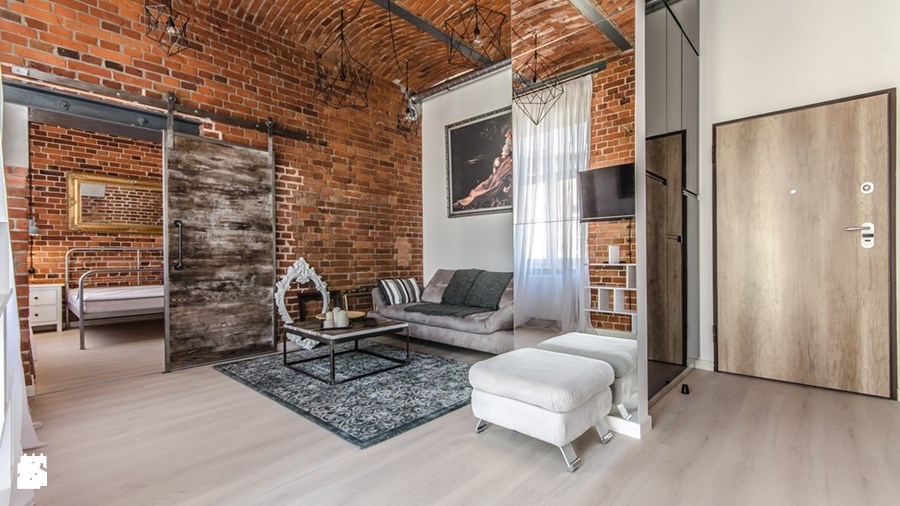
Industrial style starts with the choice of living space : lofts, open spaces are the most suitable, as, having large and airy rooms with few partitions, they perfectly imitate real industrial spaces.
In fact, it is characterized by a particular design, based on sober, essential and clear lines. In fact, in this way the furniture is functional, absolutely basic, and made of durable materials.
In addition, they have a robust simplicity and grunge appeal that allows them to be placed in any setting, from the living room to the kitchen, from the bathroom to the bedroom, in a very original way.
And this is precisely why designing and furnishing in industrial style is not an easy task.
In fact, it is necessary to choose the right space, design and furnish it without lapsing into monotony, to avoid the risk of making cold and many unwelcoming environments.
This requires open but not dispersive spaces, choosing raw but warm materials, and essential but balanced furniture.
Industrial furniture is increasingly popular thanks to its characteristics: it is modern, dynamic and at the same time whimsical.
INDUSTRIAL DESIGN
An industrial environment is an open space in which, given the absence of internal partitions presents the exposed load-bearing structure.
In fact, it often consists of reinforced concrete pillars, or, even more frequently, cast iron columns.
In fact, the rooms are usually very high and often double height, with the presence of mezzanines, which are accessed through iron stairs and in which we find study areas, offices, and sleeping areas.
If we are on the top floor of a building, the roofing slab will have exposed beams, made of wood or steel, the installations will be clearly visible.
In fact, the quintessential industrial style wants ducts and pipes not hidden but in plain sight.
The floors are made with an industrial resin or polished concrete, so there are no joints and give an additional feeling of continuity.
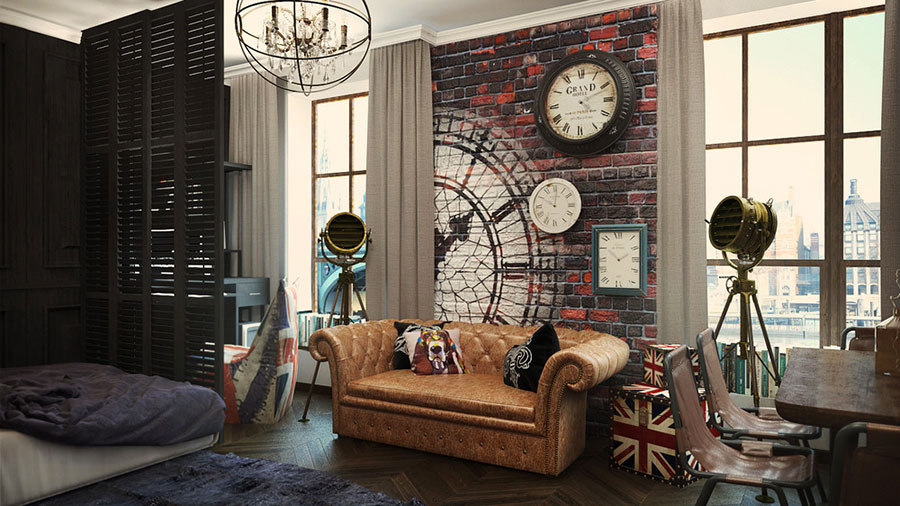
Perimeter walls are left unfinished, with light-colored plaster in shades of white, cream, taupe, or with salvaged exposed brick. Then again, a true industrial space almost always features a wall with rough bricks or finished with a coat of paint.
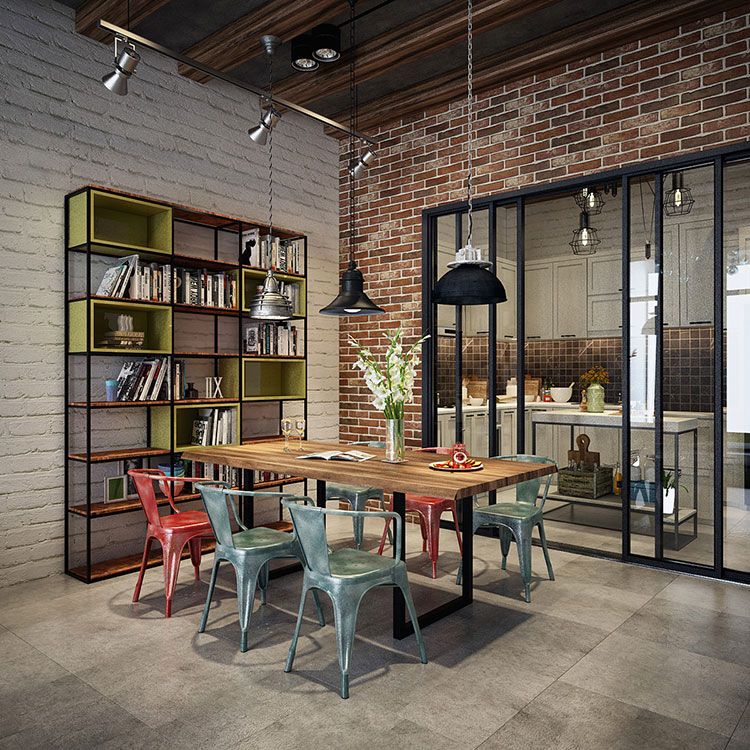
In addition, the windows are very large, just to give brightness and air to the rooms. In fact, aluminum window frames often have a quadrangular scan with alternating fixed and opening parts.
Ferrous metals are clearly the most popular, but to avoid making rooms cold, wood and copper are also very suitable.
INDUSTRIAL DESIGN
The finishing touch in a loft is provided by the furniture.
In this case, more than any other, choosing the right pieces for furniture represents the most difficult task. With just a few elements, in fact, you will have to connote the room according to the chosen style.
And industrial style is made up of essential pieces, salvage, vintage objects and furniture with clean lines.
In fact, industrial style does not hide, it shows.
Beams, pipes, bricks, you name it. Moreover, if you have chosen this style in any room of the house, you must then keep in mind all these structural aspects that any other style would have tried to hide.
Even the furniture escapes the perfection of mass-produced furniture and lets the light highlight its welds and imperfections of paint.
FURNISHING DIFFERENT ENVIRONMENTS
The living area is often composed of an open kitchen with peninsula and work surfaces on which machinery and systems are clearly visible. In addition, the table consists of a salvaged wooden platform with stylized and essential chairs.
Instead, the living room presents sofas with soft leather shapes perhaps placed around a cast iron stove, a typical element of the industrial style.
The sleeping area tries to become more welcoming with the use of rugs, bed linen, fabrics with soft and warm colors. In addition, to give the room a properly industrial feel, it is appropriate to opt for concrete, porcelain stoneware or untreated raw wood surfaces.
A kitchen in industrial style is characterized by the use of natural materials, such as wood and stone, which give the idea of lived-in.
The style is essentially understated, clean and rigorous, with rough finishes, reminiscent of those of old factories of the past.
Finally, the service rooms have the same shape as the classic ones, with an extra touch of concrete and glass in the choice of materials.
True industrial style wants the furnishings, often salvaged, such as old clocks, cabinets, iron elements of machinery, to be placed on the floor, as if they were temporary, without a real proper location.
COLOR
If there is one color that should never be missing from your industrial-style home, it is gray.
In fact, furniture or lamps made of metal materials recall industrial decor, but even fabrics for the sofa or bed can fulfill this function, if in gray.
This color can also be combined with beige, white and black. If you want to bring in some contrasting color, you can always do so with a piece of furniture outside the dominant color scheme.
FURNITURES
The ‘industrial style involves choosing a few essential pieces, if possible from salvage, such as vintage items found in all antique markets around the world.
Since the whole concept revolving around the industrial style is the redevelopment of the ugly to make it beautiful, without hiding or renovating, but rather showing the potential of the buildings that house homes, there is almost always a tendency to show “what’s underneath.”
So beams, pipes, bricks, are almost always exposed.
So, yes to sturdy furniture with clean geometries and charm grunge, rustic colors that create continuity between walls and floors.
Finally, leather armchairs and sofas, wooden and metal chairs, ceiling and neon lamps, coffee tables made from unused pallets and put back together.
LIGHT
Light is very important in this type of style because it can lighten the atmosphere, since elements such as metal furniture can be visually heavy.
The provision of natural light, filtered by large windows and glass windows with some fixtures as aesthetically simple as possible, is essential.
In fact, giving the right light to large rooms is very difficult, it is necessary to bring to life a lighting design commensurate with the activities that will take place there.
Finally, you can look for bulky, large lamps that bring direct light into the room and maintain the industrial spirit of 1950s New York lofts.
In fact, floor lamps and spotlights will alternate with those hanging lamps whose wires should be clearly visible to recall to perfection the conformation of a factory.
VERSATILITY.
Industrial style coexists with any other decoration, and this is precisely one of its main advantages.
In fact, if you have a marble fireplace in a living room this will not clash with exposed brick, metal coffee table and industrial lamps.
On the contrary, this anachronistic touch will achieve a very special effect in the living room, bringing sense of warmth and coziness.
CONCLUSIONS
As we have just seen, industrial style is very much in vogue lately, especially among the younger generation.
This is due, on the one hand, to the great influence that celebrities or prominent people have living in such environments and, furthermore, to TV series set in 1950s New York, where, indeed, this style has its birthplace.
This is a very particular style, it is well suited to any kind of design combination by setting few conditions, such as example: large spaces, mostly metallic colors and not to hide beams, partitions, etc.
By following the advice in this article, you will easily be in a position to decorate your home following the basic principles of this style. In any case, the advice is not to overdo it; the industrial style does not need gaudy colors or too much furniture elements.
So, unleash your imagination and furnish your home as you have always dreamed!

LEAVE A COMMENT
If you liked the article leave a comment with your considerations about it! We will be well happy to receive your advice.
Also, if you need guidance or just some more specific tips for decorating your home according to this style, send an email to [email protected]! We will get back to you as soon as possible!


