
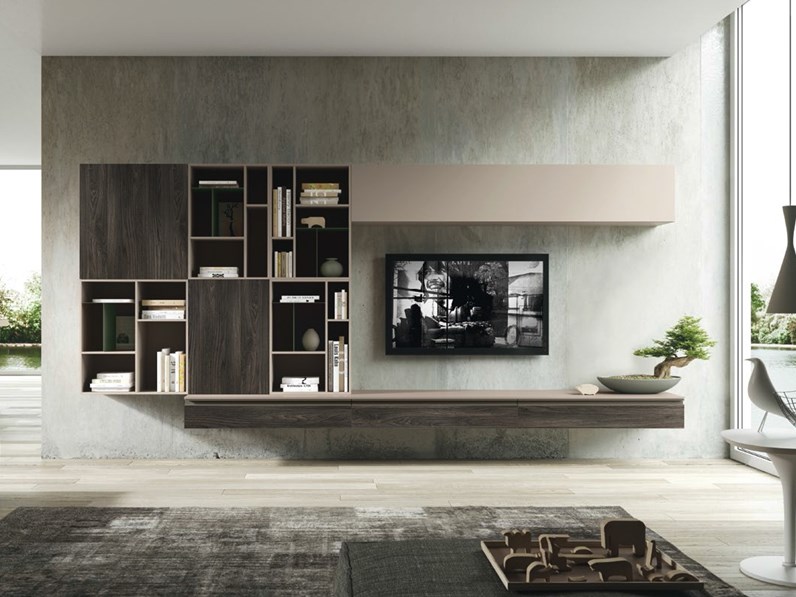
MODERN STYLE: ORIGINS
The modern style combines a set of rather “hybrid” characteristics, since it is a macro category, within which different “niche” styles can be understood.
In any case, a modern style clearly differs from a classic or rustic one, but it can also differ from the so-called “contemporary” style, since it is characterized by less aggressive details.
The modern style emerged from a revolution in the world of architecture between the wars where every design criterion and aesthetic were rethought.
It is still considered today as one of the most important movements in the history of architecture. The essence of modernism is functionality, or the need for each designed space to obtain the best possible utility.
The movement has crowned many masters still considered among the best ever, such as Le Corbusier with his ideas of social urban planning and Frank Lloyd Wright and organic architecture without forgetting the institution that has become the Bauhaus.
In 1936 in America the movement was also called International Style, precisely because of the fact that it had revolutionized the whole world somewhat.
For a young couple, singles, or those who intend to give their home decor a complete makeover, choosing a modern style for furnishing a home is one of the most natural options because it allows the greatest compromises in the available budget and the amount of furniture to buy.
After all, modern style often flows into minimalist style.
Outfitting a modern home does not necessarily translate into arranging a design object or a contemporary piece of furniture in some corner: choices must be made to create an environment in which one feels good.

MAIN FEATURES
So what does modern style mean in the sphere of furniture?
However, it remains a concept very tied to the architecture of the house that has evolved over the years. The link between beauty and purpose is indispensable, nothing can be beautiful if it is not functional.
The current modern style has inherited the concept of the original modernism but has slowly merged with the idea of minimalism of forms and spaces, which is very representative of our current contemporary times.
The materials that are used to furnish in the modern style are simple, often shiny and polished.
The spaces are calibrated in the right way between open space and furnishings and the colors tend to be neutral or dark, always solid color.
The modern style is thus characterized by the use of modern materials and furniture precisely, that is, obtained by techniques different from those of the distant past.
For example, wood is also widely used in the modern style, as in the classic style, but the treatments it undergoes are different, making it more durable and sometimes even aesthetically different.
In addition, the lines of the furniture can take different shapes, even irregular and without decorations.
The goal of the modern furniture style is to free oneself from the “weight” of large, ornament-filled, nonfunctional furniture.
The goal is to lighten rooms and make them more practical for cleaning and daily use. For these reasons, technology is also widely used in the modern furniture style.
Modern style can be softer and give feelings of calm and relaxation, or it can be cheerful and lively, with very accented touches.

CONSTITUENT ELEMENTS
So, let’s see specifically what are the constituent elements that make a home truly in line with the definition of “modern”:
- Very simple and often linear lines and shapes;
- brightness;
- Glossy or transparent surfaces;
- functionality;
- the white but not only;
- practicality and simplicity;
- Quality instead of quantity.
The most distinguishing features of the modern style are the functionality of space and an elegant simplicity. That said, there are many other elements that contribute to a truly modern-style home:
- Shapes: in modern style there is no rigidity of shapes as perhaps it is more evident in minimal style. In this style the shapes tend to be clean and simple, even irregular but always remain very calm;
- Colors: white always tends to be there in modern homes, but not only. The most commonly used colors are black and white with all their various shades, but it is becoming more and more usual to see modern houses filled with color;
- Natural light: just because modern houses are often very tied to the architecture of the building, natural light is usually always abundant. Modern houses tend to have very large windows, which let in light and brighten the space;
- Materials: in the modern style a lot of bright, smooth materials are used, treated in luxurious ways;
- Technology: modern design is becoming increasingly technological. Technology is beginning to be more and more a part of the way we furnish.
MATERIALS
In the modern furniture style, the most used materials can also be the classic ones, but treated differently. In fact, newer materials suitable for the functionality of a modern home can also be found along with them:
- As for flooring, we find: ceramic, terracotta, carpet, wood or laminate;
- For wall coverings, however, we have: plaster including colored plaster, wall paper, tiles in the kitchen and bathroom, including decorated tiles;
- The furnishings, on the other hand, range from wood to glossy or matte lacquers to the use of metal for some details;
- Finally, for upholstery: properly treated leather, but especially fabrics are the most commonly used materials.

TECHNOLOGY
Systems and technology in the house furnished in a modern style are very important, given the fundamental role that is given in this style to functionality, practicality and comfort.
In the modern house, appliances with good performance and energy saving are mandatory, modern systems, such as cooling with air conditioners and the underfloor heating system or with a condensing boiler, strategically organized electrical system, gas or electrical system for the kitchen.
Finally, audio-video systems must be integrated and sometimes well camouflaged in the décor, but they cannot be missing: televisions and stereos are in fact an inevitable part of the modern kit.

DIFFERENCE BETWEEN MODERN AND MINIMAL
Many wonder what the differences are actually between these two styles.
In fact, as the years went by, modernism definitely came closer to the concept of minimal; in fact, the minimal style originated as a facet of classical modernism!
The differences between these two styles are not always so obvious. In essence, minimal style is a type of modernism; in fact, modern style tends to be less rigid about the choice of colors and materials.
A house can be very modern and have materials such as wood for example, which in the minimal style is never used. The minimal style is more restrictive on materials, which are always linear, geometric, always tend toward white.
In minimal you see very few colors, only shades of black and white, and the style reduces furniture to an aesthetic minimum. Modern style, on the other hand, is more based on the structure of the home and the function of things.
In the minimal style, clutter is reduced as an aesthetic choice, in the modern style as a functional requirement.

LEAVE A COMMENT
If you found the article interesting, leave a comment with your considerations about it!
Finally, if you need advice or a personalized guide to make your home suitable for the characteristics of modern style, send an email to [email protected]!


