
ENERGY CERTIFICATION: INTRODUCTION
Beginning in 2005, energy certification of buildings finally became part of the Italian legislation. In fact, the energy classes were created to classify the energy performance of houses and apartments on the basis of functional and structural parameters that scientifically determine the use of electricity.
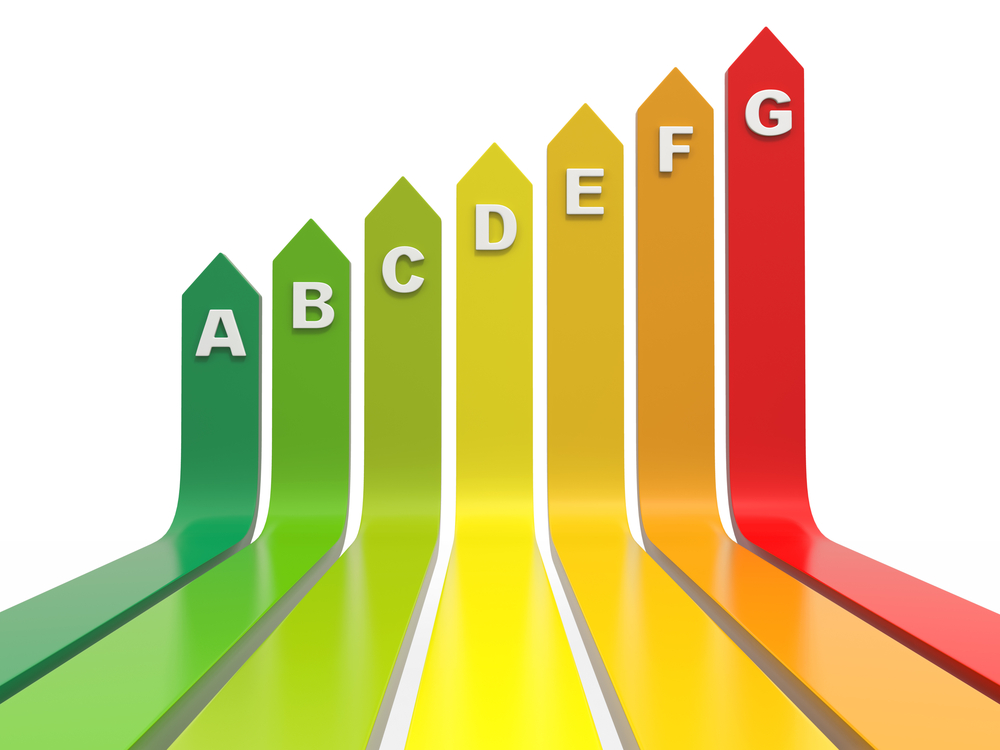
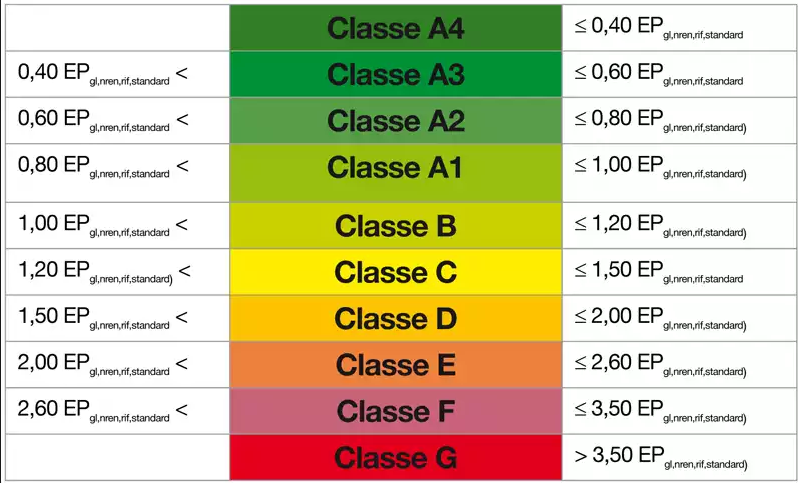
The division into classes is done on the basis of the letters of the alphabet, on a scale that ranks consumption in ascending order, starting from class A4, up to G, for a total of 10 classes.
The energy classification therefore serves to establish how much a building consumes, or rather, to assess what impact it has on the environment in terms of consumption.
To this end, the purpose of the legislature, which places therequirement for energycertification only on certain categories, is to reduce energy waste, curb consumption and spur both the citizen and the new technology market to adopt and propose alternative solutions with low environmental impact.
Energy certification of buildings is an evaluation procedure whose main purpose is to promote the improvement of the energy performance of buildings. In fact, the energy certification provides both a section for the thermal insulation class and a section relating to the quality of high energy efficiency systems.
As if this were not enough, in many Italian regions it is expected that each real estate announcement must clearly report the energy class of the property for sale. The purpose of these provisions is essentially to inform building buyers about actual energy consumption.
ENERGY CLASS
There are ten energy classes and each is
assigned a score ranging from 1 for the least efficient to 10 for the most
efficient based on specific ranges of energy values, or range
of consumption.
In the following table we have summarized the minimum and maximum values of each
class and the score assigned to them.
(the abbreviation EP indicates the energy performance index).
The calculation of the energy class is not simple. First, specific skills and professional and recognized evaluative abilities are needed. Indeed, a new professional figure associated with this field has emerged. In this regard, the energy certifier takes care of carrying out the energy diagnosis of a property in order to quantify the energy consumption of the building in standard conditions of use and climate depending on the climatic zone.
The energy certifier issues the APE, Energy Performance Certificate, which contains all the characteristics of a building from an energy point of view including the Energy Class to which the property belongs. The document should be prepared in accordance with the Guidelines issued with the Ministerial Decree of June 26, 2009 or regional guidelines if they exist.
Much will depend on the materials used in the structure, the size and fixtures, the use of renewable energy sources, the climate zone, or the improvements and optimization work you are willing to do if it is an assessment on new construction.
However, it is necessary not to rely on just any certifier. In fact, the true energy certifier must have adequate training in order to operate in accordance with the law. Therefore, choose only recognized certifiers who have valid certificates.
Low consumption results not only in energy savings for the homeowner, but also in lowering the state’s energy bill and reducing environmental pollution, the latter of which has been neglected for too long.
WHAT DOES THE NEW APE CONTAIN?
The energy certification can only be issued by legally qualified individuals and only after an inspection of the building being evaluated. The document is valid for 10 years and must contain various data including:
- First, the overall energy performance including, through their respective indices, total primary energy and non-renewable primary energy;
- the energy class, calculated through the overall energy performance index and expressed in non-renewable primary energy;
- The energy quality of the building based on the thermal performance indices for cooling and heating;
- carbon dioxide emissions;
- Energy exported;
- The proposals for improving the energy efficiency of the building;
- information on incentives and other facilities for improving the energy performance of the building;
- finally, the details of the professional who carried out the inspection, the date, and the type of software used for the evaluation.
The energy classes are no longer 8, but 10: ranging from A4, the best, and then gradually going down with A3, A2, A, B, C, D, E, F, G, the worst.

ENERGY EFFICIENCY
Before we delve into the analysis of individual energy classes, let us make a brief introduction concerning the meaning of “energy efficiency.” This expression is very fashionable today, but it is often used without knowing exactly what we are talking about.
Therefore, the energy efficiency of a building is defined as the ability that that particular system has to exploit the energy that is supplied to it and that serves to meet its daily needs in the best possible way.
An efficient home is a home that consumes little and this, evidently, has direct and significant repercussions on ordinary management costs.
So-called upgrades, aimed at improving the energy efficiency of a building, thus prove to be very useful in cutting consumption and bills, especially gas and electricity bills. In addition, it is essential to receive energy certification for one’s home.
The energy efficiency of a building can be improved by working on those factors that cause energy loss; on some of them it is obviously impossible to intervene, but on others action can certainly be taken.
For example, it is possible to insulate surfaces that are exposed to colder environments just as it is possible to intervene by insulating and improving the quality of windows and doors or the roof; in fact, replacing doors and windows can lead to considerable cuts in energy bills.
ENERGY CLASSES
But how are the energy classes of the houses divided?
Here are some useful pointers.
CLASS A
Energy class A is divided into classes A1 ,A2, A3 and A4.
It represents excellence in energy efficiency and environmental protection.
A Class A house is a home with an energy impact that corresponds to almost zero.
There is only very minimal waste.
It also obeys earthquake-resistant standards, has a coat of thermal insulation, makes use of a high efficiency heating system.
Operating costs are negligible and the living comfort within individual rooms is truly optimal.
CLASS B
The B classes are those of low consumption and sustainable.
Houses of this type have undergone upgrading, undergone work on the exterior, been subject to window replacement.
In a class B house, consumption is limited and comfort is really good: in short, all in all, one cannot really complain.
CLASS C
Energy class C characterizes all those properties that have certain main characteristics.
First of all there are thermostatic valves on all the radiators.
They have a condensing boiler and attic insulation.
It could be said that, a bit like school voting, a class C building, from an energy point of view, still deserves sufficiency, nothing more and nothing less!
You don’t have outstanding performance, but neither do you have big problems, so if you want to, you can do something to improve, but on the balance sheet you can be content.
CLASS D
Energy class D indicates those homes that were built relatively recently, about 15 years ago.
Often these houses have undergone requalification.
With class D we begin to fall below sufficiency and therefore it is good to think about implementing some intervention, albeit minimal, that will improve the situation, increasing comfort within the living quarters and limiting waste and expenses.
CLASS E
Among buildings constructed between the 1970s and 1990s the most common energy class is E.
These are homes that feature a natural gas boiler, although the construction quality of these properties is not particularly high.
Starting with class E, and then going up to class G, it is always good to ask yourself a few questions with respect to your home and what it would be desirable to do to make it more efficient, because undoubtedly in these cases it is possible and necessary to do better.
A class E house is not only a problem in terms of cost, because it has quite high consumption, but above all it is the feeling of little comfort that those who live in it have that is detrimental.
CLASS F
They indicate buildings where theheating systems are obsolete.
Many of the buildings dating from the late 1970s, early 1980s, especially if they have not been subject to any kind of intervention, fall into this class, for which everything said with respect to the previous applies.
They may also have old fixtures and not very adequate wall and floor insulation.
CLASS G
Energy class G indicatesthe least efficient class compared to all the others.
Included in this class are old buildings in masonry that have not undergone insulation work and do not have a heating system.
most of the real estate in Italy, falls into this category. Precisely for this reason, elsewhere we will dwell abundantly on this phantom and much-demonized class G, especially with the aim of understanding how to transform it into something better.
NZEB CLASS.
Now, you will naturally be led to believe that, from an energy-efficiency point of view, a class A4 house is the top, but attention you will have to think again immediately. In the near future we will all find ourselves thinking exclusively of so-called nZEB buildings, an acronym that literally translates to “ nearly Zero Energy Building,” or buildings with nearly zero energy.
An nZEB house is a very high energy performance system, so much so that it has such low energy requirements that it is practically zero. This is possible not only because consumption is minimal, but also because it is almost completely met by the exploitation of renewable sources.
Few people know this, but Legislative Decree 192/2005, later amended as a result of EU Directive 31/2013 EU, through Decree Law 63 of June 4, 2013, stipulates that in our country, all new buildings as of January 1, 2021 will have to be constructed in nZEB mode, while for what concerns public buildings the obligation has already been triggered, as of December 31, 2018.
HOW ENERGY EFFICIENCY IS CALCULATED
Energy certification is nothing more than a procedure performed by a professional technician who evaluates the energy consumption of a house or building to maintain certain environmental conditions inside.
In practice, the consumption in Kilowatts is calculated in one hour per square meter of the structure. This assessment, along with other verifications and data, determines the APE, which is the Energy Performance Certificate of the house or building. These results then place the structure within certain energy classes.
However, so many factors can affect determining the final energy efficiency rating of a structure and its placement within a particular class rather than another.
These factors, as far as a building is concerned, include, for example, its floors, insulation systems, walls, roof, fixtures and the boundaries of its walls. For a dwelling, on the other hand, apart from the aforementioned elements, its location within the building also tends to have an influence.
Then there are additional systems that can reduce still further energy consumption, such as heated floors, condensing boilers or solar panels, which are essential for achieving the most efficient energy classes, such as A4 may be.
All these elements, however, do not ensure a perfectly energy-efficient home. In fact, much depends on the heat loss encountered and, indirectly, also on the construction quality of the structure.
Fortunately, favoring this kind of work is the state, which grants special tax breaks to those who carry them out. Specifically, a refund from 50 percent to 65 percent, over a 10-year period, of expenses incurred for renovation work intended to improve the energy efficiency of buildings and homes. All through the annual tax return.
HOW TO CALCULATE THE ENERGY CLASS
There are many factors that come into play in determining the energy requirements of a building and consequently the class of itself.
The 10 energy classes basically depend on the value from the parameter Epgl,nren, which is the so-called index of global non-renewable energy performance of the building, which corresponds to the total energy consumed by the air-conditioned building per meter square area each year.
Here, then, it is important to point out that the new energy classes (as well as the previous ones) do not allow direct comparison of different buildings . To compare the performance of different buildings, one will have to read the numerical value of EPgl,nren, not the letter indicating the class to which they belong.
Keep in mind that an APE is made up of several pages and in addition to data about the property, its owner and the certifier who drafted it contains several other pieces of information:
- energy performance indexes of all the systems present;
- The energy sources used;
- The estimated annual energy consumption;
- the reference values;
- CO2 emissions;
- The energy produced and exported by the building;
- some recommendations for improvement of building energy efficiency;
- the presence of available financial incentives at the time the EPA is issued;
- The desirability of conducting further energy diagnoses or any notes.
From this it is clear that in 2017 56 percent of real estate sales involved buildings in class G, which is the worst of all, 24 percent classes E and F, 13 classes C and D, and only 7 percent of deeds of sale involved houses falling in the best energy classes, A and B.
At the same time, one in two of all real estate agents surveyed believe that the EPA does not carry much weight in the final choice of those about to buy.

ENERGY CERTIFICATION: CONCLUSIONS
RELY ON AN EXPERT
Recent studies show that in Europe about 40 percent of total energy is used in residential and tertiary use, and the only plausible way to lower emission levels is to make energy efficiency improvements in buildings.
Therefore, Legislative Decree number 192 of 2005 takes over which establishes the obligation of energy certification of buildings with the drafting with the issue of an APE Energy Performance Certificate that assigns the energy class to the house.
To understand how we can improve the energy class of a building and consequently start saving on home consumption first we need to find out the factors that cause energy loss.
You can then start by requesting a quote from a building renovation company that can perform a survey at the property and advise you on what changes need to be made to improve the energy class of the property resulting in lower consumption and thus lower costs.
A really effective way to improve energy class and lower consumption, making the property acquire a much higher value than before is undoubtedly through the installation of photovoltaic panels that can substantially lower consumption.
This type of intervention is very convenient because it falls within the Ecobonus which allows you to have a tax deduction of up to 65% on the purchase of photovoltaic panels.
SALES PRICE CHANGES
Regarding the impact of energy classes on the value of a property, we can say that similar properties but with different energy classes can experience a fluctuation on the selling price that can vary and even reach 30% depending on whether they are in class A or G.
That is why you should request a survey by a renovation company, at least to realize how much it would cost to improve your property in terms of energy class through targeted interventions, if you resell the property in the future you may be able to earn several thousand euros always taking into account the tax bonuses extended again this year that allow you to save on renovation.
It has to be said that improving energy class through renovation or buying a class A apartment over a class G one can bring multiple benefits over time in terms of consumption and property value that can extend over time.
As a result, improving the energy class of a property and requiring a new energy certification can increase the value of the property with huge benefits in terms of economic investment.
LEAVE A COMMENT
If the article interested you and the topic is important to you because of an imminent renovation aimed at improving the energy class of the home, you can leave a comment at the end of the article!
In addition, if you have doubts and need advice to get personalized advice on how to use this type of intervention and how to receive your energy certification, you can send an email to[email protected]


